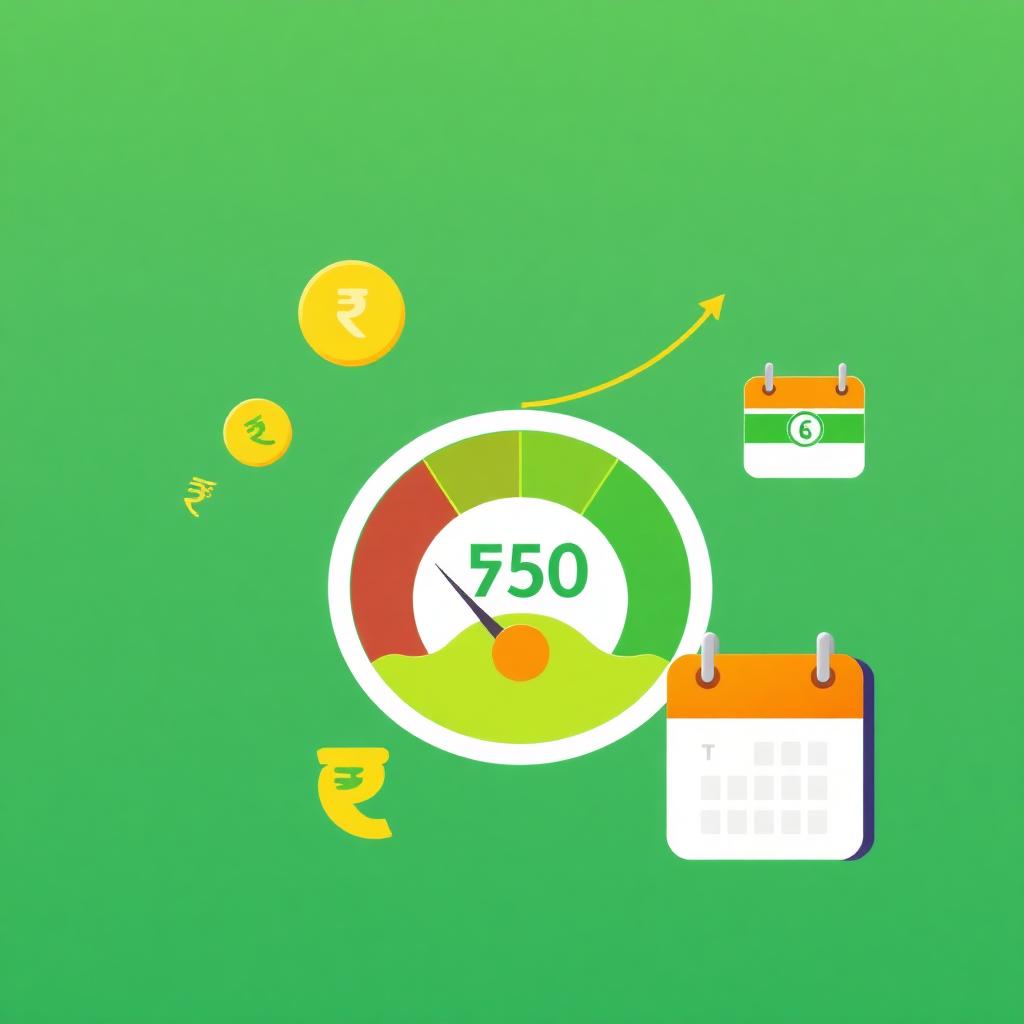
Most Indians discover their CIBIL score only when a home-loan officer rejects their file. A score of 650 is not "bad" — it's the grey zone where banks quietly load 1-2% extra interest on your car loan, credit card and personal loan. On a ₹40 lakh home loan for 20 years, that gap between 650 and 750+ costs you nearly ₹8-10 lakh in extra interest. The good news: with salary pressure, rising EMIs and inflation squeezing budgets, a 100-point jump is achievable in 6 months without any fancy trick — just disciplined credit behaviour. This guide is the exact playbook Indian borrowers use in 2026 to move from 650 to 750+ and unlock the cheapest interest rates.
Quick Snapshot: 6-Month CIBIL Improvement Plan
| Month | Focus Area | Expected Score Gain |
|---|---|---|
| Month 1 | Pull free CIBIL report + dispute errors | +10-20 |
| Month 2 | Drop credit utilisation below 30% | +15-25 |
| Month 3 | Automate EMI + credit card full payments | +10-15 |
| Month 4 | Close unused loans, keep old cards open | +5-10 |
| Month 5 | Add a secured card or small-tenure loan if thin file | +10-20 |
| Month 6 | Stabilise — no new applications | +10-15 |
Total realistic gain: 60-105 points. Starting at 650, that lands you between 710 and 755.
Why 750+ Matters (Real ₹ Numbers)
A 750+ CIBIL score in India unlocks:
- Home loan rate: ~8.35% vs 9.75% for 650 — ~1.4% cheaper.
- Personal loan rate: ~10.5% vs 16-18% for 650.
- Credit card limit: 3-4× monthly salary vs 1× at 650.
- Auto approval: Pre-approved offers from HDFC, ICICI, SBI, Axis.
On a ₹40 L, 20-year home loan, a 1.4% rate cut saves ~₹8.2 lakh in total interest and drops the EMI by ~₹3,200/month. That is your annual family vacation, paid for by one CIBIL score.
Detailed Explanation: The 5 Levers That Move Your Score
1. Payment History (35% weightage)
One missed EMI or credit card minimum payment can pull your score down by 40-70 points and stay on your report for 24 months. Set every EMI, card bill and BNPL to auto-debit on salary day + 1. Never rely on memory.
2. Credit Utilisation (30% weightage)
If your card limit is ₹1,00,000 and your outstanding is ₹80,000, utilisation is 80% — CIBIL treats this as high-risk. Keep total utilisation across all cards below 30%, ideally below 10% in the month the score is reported. Two tricks: (a) pay the bill twice — mid-cycle and on due date, (b) request a limit increase every 12 months (doesn't cost anything, cuts utilisation instantly).
3. Credit Age (15% weightage)
Length of your oldest credit line matters. Never close your first credit card — even if you don't use it, keep it active with a ₹300 recurring bill on auto-debit. Closing a 7-year card can drop your score by 20-30 points.
4. Credit Mix (10% weightage)
CIBIL prefers a mix of secured (home/car loan) and unsecured (credit card, personal loan). A file with only 3 credit cards and no term loan looks thin. If you have never taken a loan, a small consumer-durable EMI (say ₹15,000 for a phone over 6 months, paid fully) builds the mix.
5. New Credit Inquiries (10% weightage)
Every "hard" enquiry (loan/card application) shaves 3-8 points and stays for 2 years. Do not apply for 3 loans in one week hoping one gets approved — each rejection compounds the damage. Space applications at least 90 days apart.
Age-wise CIBIL Strategy for Indians
- 22-27 (early career): Get one entry-level credit card, use ₹5,000/month, pay in full. That's it. Do not chase rewards cards.
- 28-35 (peak EMI years): You'll have home loan + car loan + 2 cards. Keep utilisation <30%, never miss a due date. This is where 750+ is built.
- 36-45 (consolidation): Close 1-2 low-value cards, keep the oldest and highest-limit ones. Refinance high-rate loans.
- 45+ (pre-retirement): Focus on being debt-free. Score matters less unless planning a business loan.
Calculation Method: How CIBIL Actually Scores You
CIBIL uses a weighted model on a 300-900 scale:
Score = 0.35 × Payment_History
      + 0.30 × Utilisation
      + 0.15 × Credit_Age
      + 0.10 × Credit_Mix
      + 0.10 × Enquiries
Example — moving from 650 to 750:
- Baseline (650): 2 missed payments in last 12 months, 78% utilisation, 4 enquiries in 6 months.
- After 6 months: 0 missed payments, 22% utilisation, 0 new enquiries.
- Impact: +40 from utilisation, +25 from clean payment history, +10 from ageing, +15 from no new enquiries = ~+90 points → 740.
Mid-article CTA: Before you apply for that home loan, check the real EMI at both 650 and 750 rates on the FundGenie EMI Calculator — the difference will motivate you to fix the score first.
Common Mistakes Indians Make
- Checking CIBIL from loan aggregators repeatedly — some trigger hard enquiries. Use CIBIL's own free annual report or a soft-pull service.
- Closing credit cards to "look responsible" — kills credit age and raises utilisation on remaining cards.
- Paying only the minimum due on credit cards — interest at 36-42% p.a. eats into the score AND your salary.
- Co-signing / guaranteeing a friend's loan — their default becomes your default on CIBIL.
- Ignoring small settled defaults — even a ₹1,500 unpaid phone bill sent to collections drops score by 50+ points.
- Applying for a loan the moment a card is issued — thin new credit + inquiry = double hit.
- Assuming score updates instantly — CIBIL reports refresh once every 30-45 days. Improvement is visible only after 1-2 cycles.
Step-by-Step 6-Month Action Plan
Try on FundGenie
Model the impact of a better score on real EMIs:
- EMI Calculator — see how a 1% rate cut changes your 20-year home-loan payment.
- Tax Calculator — home loan interest under old regime = extra ₹2 L deduction. Check your net tax.
- SIP Calculator — invest the EMI savings from a better score into a step-up SIP.
Final CTA: Plan your loan and SIPs together on FundGenie — India's most honest financial calculators, built for 2026.
FAQ
How long does it take to improve CIBIL from 650 to 750 in India?
Realistically 6-9 months of disciplined behaviour — clean payments, utilisation under 30%, no new enquiries. CIBIL refreshes every 30-45 days, so you'll see monthly progress.
Does checking my CIBIL score reduce it?
No. Soft enquiries (self-checks via cibil.com or apps like OneScore, Paisabazaar's soft pull) have zero impact. Only hard enquiries by lenders drop the score by 3-8 points each.
What is a good CIBIL score for a home loan in India in 2026?
750+ gets you the best rate (~8.35-8.65%). 700-749 is acceptable but pricier. Below 700, banks either reject or charge 1-2% extra.
Can I get a personal loan with 650 CIBIL score?
Yes, but at 16-22% interest instead of 10.5-13%. NBFCs like Bajaj Finserv and Fibe approve 650 scores; big banks like HDFC/ICICI usually decline.
How to fix a CIBIL score after a defaulted loan?
Settle the outstanding fully (not "settled" status — that hurts). Get a No-Objection Certificate. Wait 12-24 months while maintaining clean utilisation. Add a secured credit card to rebuild.
Does closing a credit card improve CIBIL score?
No — usually the opposite. Closing an old card shortens credit age and pushes utilisation up on remaining cards. Keep old cards active with a small recurring payment.
How many credit cards should I have for a 750+ CIBIL score?
2-3 cards is optimal. One primary (highest limit), one older card (for credit age), and optionally one for rewards. More than 4 becomes hard to manage and utilisation slips.
Is 750 CIBIL enough for a ₹50 lakh home loan?
Yes — 750+ qualifies for the best home-loan rates from HDFC, SBI, ICICI, Axis and LIC HFL. You'll still need income proof (salary ~₹75K/month+) and stable job history.
Did you find this useful?